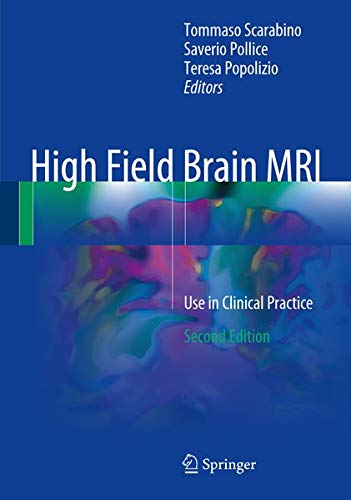
Omslagsbild från Amazon
Bild från Amazon.com

High Field Brain MRI [electronic resource] : Use in Clinical Practice / edited by Tommaso Scarabino, Saverio Pollice, Teresa Popolizio.

Medverkande: Materialtyp: TextUtgivningsuppgift: Cham : Springer International Publishing : Imprint: Springer, 2017Utgåva: 2nd ed. 2017Beskrivning: IX, 391 p. 175 illus., 82 illus. in color. online resourceInnehållstyp:
  • text
Medietyp:
  • computer
Bärartyp:
  • online resource
ISBN:
  • 9783319441740
Ämnen: Fler format: Printed edition:: Ingen titelDDK-klassifikation:
  • 616.0757 23
Library of Congress (LC) klassifikationskod:
  • R895-920
Onlineresurser:
Innehåll:
Techniques and Semeiotics -- High-Field MRI and Safety: I. Installation -- High-Field MRI and Safety: II. Utilization -- 3.0 T MRI Diagnostic Features: Comparison with Lower Magnetic Fields -- Standard 3.0 T MR Imaging -- 3.0 T MR Angiography -- 3.0 T MR Spectroscopy -- 3.0 T Diffusion Studies -- Nerve Pathways with MR Tractography -- 3.0 T Perfusion Studies -- High-Field Strength Functional MRI -- Recent Developments and Prospects in High-Field MR -- 3.0 T Brain MRI: A Pictorial Overview of the Most Interesting Sequences -- Applications -- High-Field Neuroimaging in Traumatic Brain Injury -- 3.0 T Imaging of Ischaemic Stroke -- High-Field Strength MRI (3.0 T or More) in White Matter Diseases -- High-Field Neuroimaging in Parkinson’s Disease -- High-Field 3 T Imaging of Alzheimer Disease -- 3.0 T Imaging of Brain Tumours -- Use of fMRI Activation Paradigms: A Presurgical Tool for Mapping Brain Function.
I: Springer eBooksSammanfattning: This richly illustrated book summarizes the state of the art in brain MRI with the 3-Tesla high-field scanner. The aim is to clarify the numerous advantages of using a 3-T high magnetic field MR scanner, especially in terms of sensitivity and specificity. The first section describes techniques for standard MR examination of the brain. Full descriptions are then provided of advanced protocols such as MR angiography, diffusion-weighted imaging (DWI), perfusion-weighted imaging (PWI), MR spectroscopy, MR tractography, and functional imaging. Differences in diagnostic features when performing these examinations at 3 T and at 1.5 T are highlighted. In addition, safety issues relating to the installation and use of a high-field scanner are discussed. The second section then describes and illustrates in detail each of the main clinical applications of 3-T MRI in the human brain: trauma, stroke, white matter disease, Parkinson’s disease, Alzheimer’s disease, brain tumors, inflammatory disease, psychiatric disorders, etc. A final chapter is dedicated to the evaluation of 7-T MRI within both research and potential clinical settings. The book will be a valuable tool for general radiologists, neuroradiologists, trainees, and technicians.
Taggar från det här biblioteket: Den aktuella titeln har inga taggar från det här biblioteket. Logga in för att lägga till taggar.
Betyg
    Medelbetyg: 0.0 (0 röster)
Inga fysiska exemplar för denna post

Techniques and Semeiotics -- High-Field MRI and Safety: I. Installation -- High-Field MRI and Safety: II. Utilization -- 3.0 T MRI Diagnostic Features: Comparison with Lower Magnetic Fields -- Standard 3.0 T MR Imaging -- 3.0 T MR Angiography -- 3.0 T MR Spectroscopy -- 3.0 T Diffusion Studies -- Nerve Pathways with MR Tractography -- 3.0 T Perfusion Studies -- High-Field Strength Functional MRI -- Recent Developments and Prospects in High-Field MR -- 3.0 T Brain MRI: A Pictorial Overview of the Most Interesting Sequences -- Applications -- High-Field Neuroimaging in Traumatic Brain Injury -- 3.0 T Imaging of Ischaemic Stroke -- High-Field Strength MRI (3.0 T or More) in White Matter Diseases -- High-Field Neuroimaging in Parkinson’s Disease -- High-Field 3 T Imaging of Alzheimer Disease -- 3.0 T Imaging of Brain Tumours -- Use of fMRI Activation Paradigms: A Presurgical Tool for Mapping Brain Function.

This richly illustrated book summarizes the state of the art in brain MRI with the 3-Tesla high-field scanner. The aim is to clarify the numerous advantages of using a 3-T high magnetic field MR scanner, especially in terms of sensitivity and specificity. The first section describes techniques for standard MR examination of the brain. Full descriptions are then provided of advanced protocols such as MR angiography, diffusion-weighted imaging (DWI), perfusion-weighted imaging (PWI), MR spectroscopy, MR tractography, and functional imaging. Differences in diagnostic features when performing these examinations at 3 T and at 1.5 T are highlighted. In addition, safety issues relating to the installation and use of a high-field scanner are discussed. The second section then describes and illustrates in detail each of the main clinical applications of 3-T MRI in the human brain: trauma, stroke, white matter disease, Parkinson’s disease, Alzheimer’s disease, brain tumors, inflammatory disease, psychiatric disorders, etc. A final chapter is dedicated to the evaluation of 7-T MRI within both research and potential clinical settings. The book will be a valuable tool for general radiologists, neuroradiologists, trainees, and technicians.

Det finns inga kommentarer om exemplaret.

för att skicka en kommentar.
Medicinska biblioteket, Karlskoga lasarett
Måndag och onsdag: 10.00-14.30, Lunchstängt 11.30-12.00.
Fredagar: 10.00-12.00.

Madelene Ribbing, bibliotekarie
Lena Mileraux, biblioteksassistent/administratör
0586-664 49
medbibl.kgalas@regionorebrolan.se


Medicinska biblioteket, Lindesbergs lasarett
Dörren till bibliotket är upplåst mellan 07-16:00 på vardagar.
Dörren i hisshallen är öppen måndag - tosdag 7.00 - 15.00. Fredagar stängt.

Bibliotekets bemanning:
Mån: självbetjäning
Tis, ons och tors: 10-15
Fre: självbetjäning

Madelene Ribbing, bibliotekarie
Telefon: 0581-853 11, 072-14 77 552
medbibl.lbglas@regionorebrolan.se