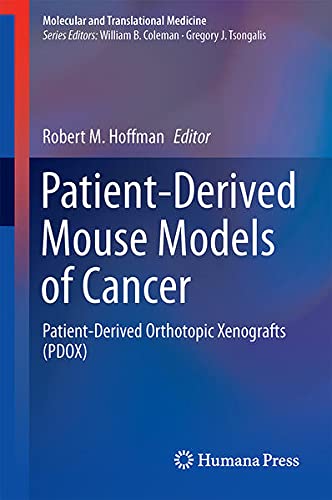
Omslagsbild från Amazon
Bild från Amazon.com

Patient-Derived Mouse Models of Cancer [electronic resource] : Patient-Derived Orthotopic Xenografts (PDOX) / edited by Robert M. Hoffman.

Medverkande: Materialtyp: TextSerie: Molecular and Translational MedicineUtgivningsuppgift: Cham : Springer International Publishing : Imprint: Humana Press, 2017Beskrivning: XVI, 296 p. 60 illus., 50 illus. in color. online resourceInnehållstyp:
  • text
Medietyp:
  • computer
Bärartyp:
  • online resource
ISBN:
  • 9783319574240
Ämnen: Fler format: Printed edition:: Ingen titelDDK-klassifikation:
  • 616.994 23
Library of Congress (LC) klassifikationskod:
  • RC254-282
Onlineresurser:
Innehåll:
In memorium: Jorgen Rygaard (1934-2016) Father of patient derived mouse models of cancer and modern cancer research -- The revival of patient-derived mouse models of cancer: way back to the future -- Patient-derived xenograft models for human cancer, The Freiburg experience -- From Ectopic to Orthotopic Tumor Grafting Sites: Evidence for a Critical Role of the Host Tissue Microenvironment for the Actual Expression of the Malignant Phenotype -- The Effects of the Organ Microenvironment on Metastatic-Cell Gene Signatures -- Techniques for surgical orthotopic implantation of human tumors to immunodeficient mice -- The first patient-derived orthotopic xenograft (PDOX) mouse models of cancer: Cancer of the colon, pancreas, lung, breast, ovary, and mesothelioma -- Patient-derived xenograft models of prostate cancer -- Patient-Derived Mouse Models of Sarcoma -- Cervical cancer patient-derived orthotopic xenograft (PDOX) models -- The use of pediatric patient-derived xenografts for identifying novel agents and combinations -- Development of Orthotopic and Spontaneous Metastatic Human Tumor Xenograft Models for Experimental Therapeutics -- Use of patient-derived orthotopic xenografts (PDOX) to evaluate transformative cancer therapeutics -- Fluorescent protein-expressing transgenic nude mice as hosts for patient tumors -- Fluorescence imaging of tumors in human patient-derived orthotopic xenograft (PDOX) mouse models: The iPDOX model -- The use of patient-derived orthotopic xenograft (PDOX) models to develop curative fluorescence-guided surgery of cancer.-Molecular characteristics of patient-derived tumor xenografts: genomic similarity to patient tumors and relevance for biomarker discovery -- Complementarity of patient-derived orthotopic xenografts (PDOX) models and molecular profiling for optimal therapy -- 3D Cell Culture Models -- Why patient derived mouse models need to be orthotopic -- Foreward: The future of patient-derived models of cancer. .
I: Springer eBooksSammanfattning: This text highlights seminal discoveries and also provides comprehensive and state-of the-art approach to mouse models of human patient tumors. These areas include training, basic techniques, as well as general troubleshooting. Subsequent chapters focus on the different mouse models of patient tumors including the various strains of immunodeficient mice currently available and the transplantation techniques that can be used as well as state-of-the-art imaging techniques. Practical applications of the models from drug discovery, genome analysis to personalized treatment are also covered. Written by experts in that field, each of these sections address these critical issues. A brief review of the existing literature addressing the particular topic follows in each section. Presently, there is no single source to provide information on technique and uses of mouse models of human patient tumors. Patient-Derived Mouse Models of Cancer will satisfy this need for cancer researchers, oncologists, pharmaceutical and biotechnology industry scientists as well as molecular biologists studying in vivo systems.
Taggar från det här biblioteket: Den aktuella titeln har inga taggar från det här biblioteket. Logga in för att lägga till taggar.
Betyg
    Medelbetyg: 0.0 (0 röster)
Inga fysiska exemplar för denna post

In memorium: Jorgen Rygaard (1934-2016) Father of patient derived mouse models of cancer and modern cancer research -- The revival of patient-derived mouse models of cancer: way back to the future -- Patient-derived xenograft models for human cancer, The Freiburg experience -- From Ectopic to Orthotopic Tumor Grafting Sites: Evidence for a Critical Role of the Host Tissue Microenvironment for the Actual Expression of the Malignant Phenotype -- The Effects of the Organ Microenvironment on Metastatic-Cell Gene Signatures -- Techniques for surgical orthotopic implantation of human tumors to immunodeficient mice -- The first patient-derived orthotopic xenograft (PDOX) mouse models of cancer: Cancer of the colon, pancreas, lung, breast, ovary, and mesothelioma -- Patient-derived xenograft models of prostate cancer -- Patient-Derived Mouse Models of Sarcoma -- Cervical cancer patient-derived orthotopic xenograft (PDOX) models -- The use of pediatric patient-derived xenografts for identifying novel agents and combinations -- Development of Orthotopic and Spontaneous Metastatic Human Tumor Xenograft Models for Experimental Therapeutics -- Use of patient-derived orthotopic xenografts (PDOX) to evaluate transformative cancer therapeutics -- Fluorescent protein-expressing transgenic nude mice as hosts for patient tumors -- Fluorescence imaging of tumors in human patient-derived orthotopic xenograft (PDOX) mouse models: The iPDOX model -- The use of patient-derived orthotopic xenograft (PDOX) models to develop curative fluorescence-guided surgery of cancer.-Molecular characteristics of patient-derived tumor xenografts: genomic similarity to patient tumors and relevance for biomarker discovery -- Complementarity of patient-derived orthotopic xenografts (PDOX) models and molecular profiling for optimal therapy -- 3D Cell Culture Models -- Why patient derived mouse models need to be orthotopic -- Foreward: The future of patient-derived models of cancer. .

This text highlights seminal discoveries and also provides comprehensive and state-of the-art approach to mouse models of human patient tumors. These areas include training, basic techniques, as well as general troubleshooting. Subsequent chapters focus on the different mouse models of patient tumors including the various strains of immunodeficient mice currently available and the transplantation techniques that can be used as well as state-of-the-art imaging techniques. Practical applications of the models from drug discovery, genome analysis to personalized treatment are also covered. Written by experts in that field, each of these sections address these critical issues. A brief review of the existing literature addressing the particular topic follows in each section. Presently, there is no single source to provide information on technique and uses of mouse models of human patient tumors. Patient-Derived Mouse Models of Cancer will satisfy this need for cancer researchers, oncologists, pharmaceutical and biotechnology industry scientists as well as molecular biologists studying in vivo systems.

Det finns inga kommentarer om exemplaret.

för att skicka en kommentar.
Medicinska biblioteket, Karlskoga lasarett
Måndag och onsdag: 10.00-14.30, Lunchstängt 11.30-12.00.
Fredagar: 10.00-12.00.

Madelene Ribbing, bibliotekarie
Lena Mileraux, biblioteksassistent/administratör
0586-664 49
medbibl.kgalas@regionorebrolan.se


Medicinska biblioteket, Lindesbergs lasarett
Dörren till bibliotket är upplåst mellan 07-16:00 på vardagar.
Dörren i hisshallen är öppen måndag - tosdag 7.00 - 15.00. Fredagar stängt.

Bibliotekets bemanning:
Mån: självbetjäning
Tis, ons och tors: 10-15
Fre: självbetjäning

Madelene Ribbing, bibliotekarie
Telefon: 0581-853 11, 072-14 77 552
medbibl.lbglas@regionorebrolan.se